
Structured real-time output

The engine uses the OpenAI API with structured output. Every response matches a schema the rendering pipeline expects. Users see a usable canvas, not text that needs correcting.
Client project · Delivered. A prompt-to-canvas engine that translates an idea into a valid, structured canvas in real time. It includes extensible AI canvas tools and natural voice input.
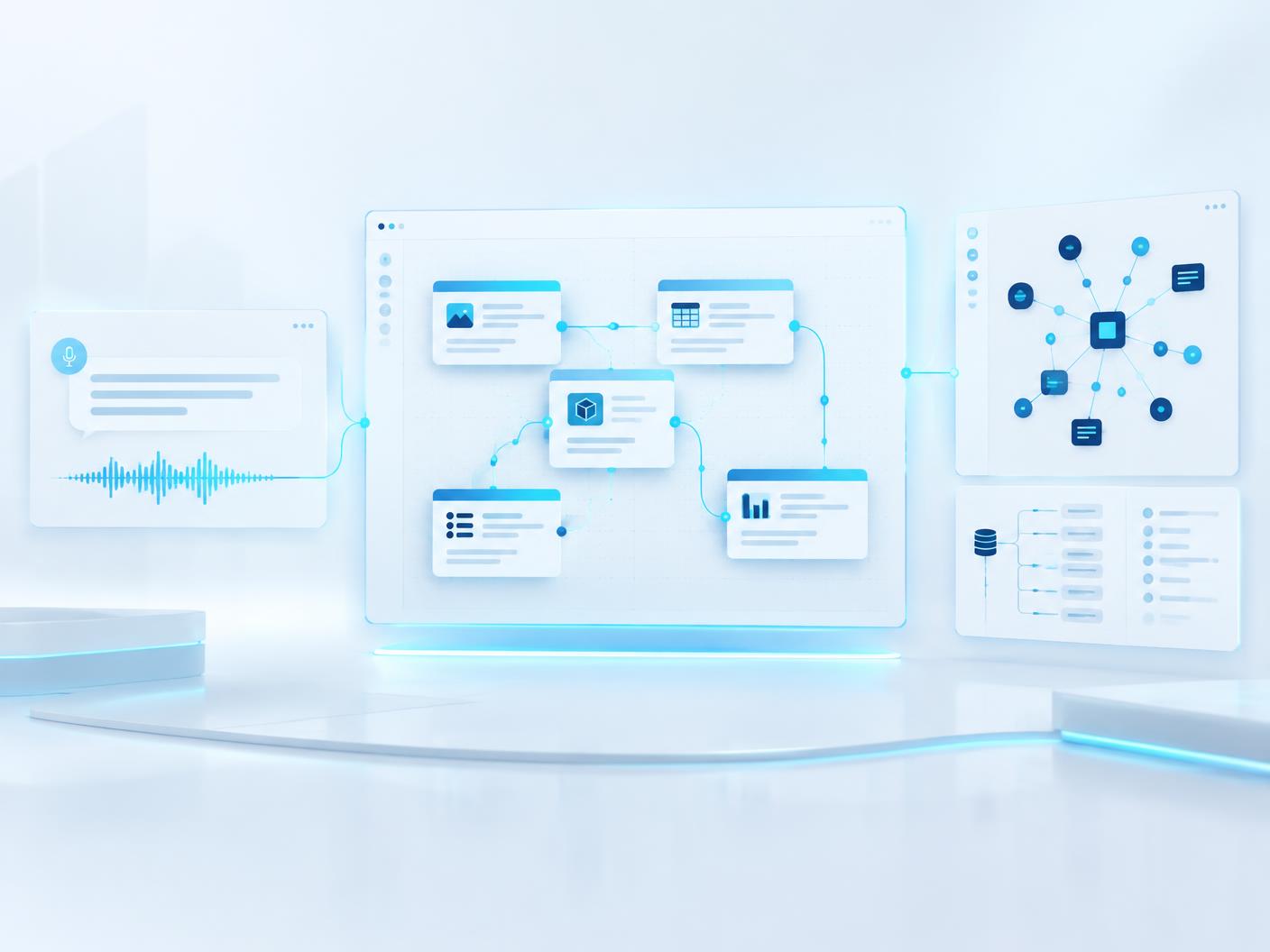
The core engine interprets a user's request and produces schema-compliant canvas configurations rather than unstructured text, allowing the product to render useful visual outputs immediately.
As the product matured, we designed and implemented a custom Model Context Protocol server so new tools and canvas operations could be added without binding the experience to one narrow prompt flow.
The engine uses the OpenAI API with structured output. Every response matches a schema the rendering pipeline expects. Users see a usable canvas, not text that needs correcting.

As the platform matured, we moved the architecture onto a custom Model Context Protocol (MCP) server. The AI gained a defined way to call the platform's tools and work with the rendering pipeline.
New canvas operations can be added as tools on the server. The product can grow without rewriting one long prompt flow.

Voice input runs on a self-hosted deployment of OpenAI's Whisper. Users can speak to the platform instead of typing.
Self-hosted speech-to-text lets users work naturally while the same validation and structured-output rules continue to govern what reaches the canvas.
As a SiegePal security engagement, our team audited the platform against the Washington Technology Solutions (WaTech) security standards. That work came before a Washington State government agency went live on the platform. The team mapped controls to the state requirements and worked with developers to close the findings. It also supported the pre-go-live security sign-off.
The platform runs on AWS, using Amazon Elastic Kubernetes Service (EKS) and AWS Lambda. Generative AI is only useful in a product when its output can be trusted by the code that receives it. Structured output, a defined tool interface, and validated voice input all serve that goal. The same thinking shapes our AI integration and AI agent development work.
Tell us what your application needs the AI to produce. We'll look at how to make its output reliable enough to build on.
Walk us through a process